Most people put off estate planning. They assume it’s only for the wealthy, or something to deal with later. Scott Kapusta has spent nearly 20 years in legal and financial services helping families get past both assumptions.
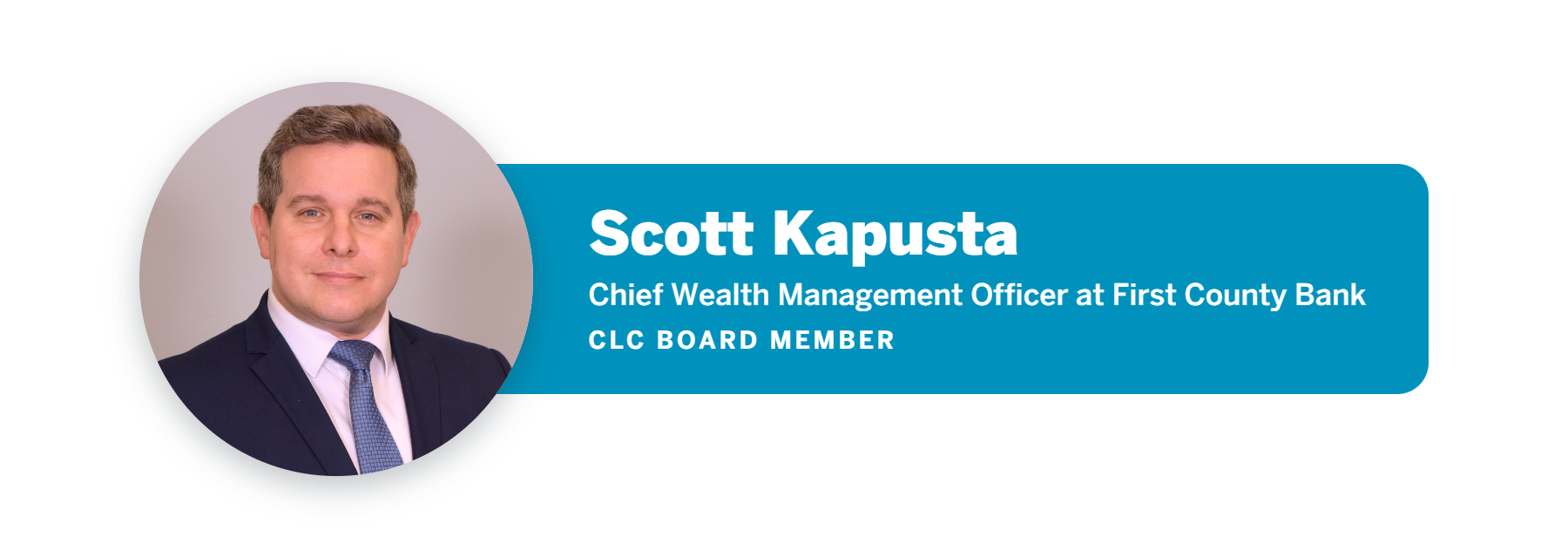
Scott is Chief Wealth Management Officer at First County Bank and a member of CLC’s Board of Directors. He’s also the parent of a young child. That gives him a view from both sides: what a plan protects for your family, and what a gift in that plan can do for Stamford’s children for decades to come. For National Estate Planning Awareness Week, October 19–25, we asked Scott where to start, what parents of young children should do first, and how to provide for your family while still leaving something to the causes you care about. His answers are practical, and they apply whether your estate is large or modest.
Why is estate planning important, and why should people think about it even if they don’t consider themselves wealthy?
One of the biggest misconceptions about estate planning is that it’s only necessary for people with substantial wealth. In reality, estate planning is about much more than money. It’s about protecting your family, making your wishes known, and ensuring that the people and causes important to you are provided for. A comprehensive estate plan addresses questions such as who would care for your children, who would make financial or medical decisions if you became incapacitated, and how your assets should be distributed.
It also creates an opportunity to think about the legacy you want to leave. For some, that means providing financial security for future generations. For others, it includes supporting charitable organizations that reflect their values. Regardless of the size of someone’s estate, thoughtful planning can make a meaningful difference for the people and communities they care about.

For parents with young children, what estate planning considerations should be a priority?
For parents, estate planning is fundamentally about protecting their children and providing for their future. One of the most important considerations is nominating a guardian who could care for their children if both parents were unable to do so. Equally important is determining how financial assets would be managed for their benefit.
A properly structured trust, for example, can provide resources for education, healthcare, and other needs while ensuring those assets are managed responsibly. Parents should also evaluate their life insurance coverage and review beneficiary designations. Beyond these practical considerations, estate planning provides an opportunity to think about the values we want to pass along to our children. Families can incorporate charitable giving into their plans and involve children in decisions about supporting causes that matter to them.
Teaching children the importance of generosity and community involvement can be just as meaningful as the financial resources we leave behind.
What are the essential components of a good estate plan, and how often should it be reviewed?
Although every family’s circumstances are different, most estate plans begin with a few foundational documents.
A will provides instructions for distributing certain assets and allows parents to nominate guardians for minor children. A durable power of attorney authorizes someone to manage financial matters if you’re unable to do so, while healthcare directives address medical decision-making. Trusts can also be useful for managing assets, protecting beneficiaries, and accomplishing specific financial or charitable objectives.
An often-overlooked component is reviewing beneficiary designations on retirement accounts and life insurance policies. These designations generally control how those assets pass, regardless of what a will says. I typically encourage people to review their plans every three to five years, or following significant life events such as marriage, divorce, the birth of a child, or retirement. These reviews are also an opportunity to revisit charitable intentions. The organizations and causes we care about may evolve over time, and our estate plans should reflect those priorities.
What are some common estate planning mistakes, particularly when it comes to charitable giving?
The most common mistake is simply waiting too long to begin. People often assume estate planning is something they can address later, but unexpected events can happen at any age. Another mistake is failing to coordinate different elements of the plan. A will, trust, beneficiary designations, and account ownership arrangements should work together. Otherwise, the ultimate distribution of assets may not reflect someone’s intentions.
From a charitable planning perspective, individuals sometimes assume that their family will know which organizations they would want to support. Unfortunately, good intentions don’t necessarily translate into charitable gifts without clear instructions. If supporting a nonprofit is important to you, it’s worth documenting that intention through an appropriate estate planning arrangement.
I also encourage people to discuss their charitable priorities with family members. Those conversations can help ensure their wishes are understood and create opportunities for multiple generations to participate in philanthropy.
How can individuals incorporate charitable giving into their estate plans while still prioritizing their family’s financial security?
Providing for family should generally be the starting point of any estate plan. The good news is that supporting loved ones and supporting charitable causes aren’t mutually exclusive. There are several ways to incorporate philanthropy without compromising a family’s financial security. For example, an individual might leave a small percentage of their estate to a charitable organization, with the remainder passing to family members. Others may designate a charity as the beneficiary of a portion of a retirement account or life insurance policy.
These approaches can allow people to maintain control of their assets during their lifetime while establishing a future charitable commitment. The appropriate strategy depends on personal circumstances, but an important point is that charitable legacy giving doesn’t require extraordinary wealth. A relatively modest bequest can make a meaningful difference to an organization, particularly when combined with the generosity of other donors.
Thoughtful planning allows people to balance their responsibilities to family with their desire to make a lasting contribution to their community.
What are donor-advised funds, and how can they help families incorporate philanthropy into their financial and legacy plans?
Donor-advised funds, or DAFs, have become an increasingly popular way for individuals and families to organize their charitable giving. A donor contributes cash, appreciated securities, or other eligible assets to a charitable account administered by a sponsoring organization. The contribution may qualify for an immediate tax deduction, while the donor retains the ability to recommend grants to qualified charitable organizations over time.
One of the advantages of a DAF is flexibility. Individuals can make contributions when it makes financial sense and decide when and where to recommend charitable grants. This can be especially useful for someone experiencing a significant income event or looking to establish a more structured approach to philanthropy. DAFs also offer an opportunity to involve children and other family members in charitable decisions, helping establish a tradition of giving across generations.
Many DAF sponsors also allow donors to establish successor advisors or provide recommendations for how remaining assets should be distributed after their lifetime, subject to the sponsor’s policies. For families who want to make charitable giving an ongoing part of their financial lives, a DAF can be an effective tool. To learn more visit our blog: Donor-Advised Funds: Your Questions Answered
What is a qualified charitable distribution (QCD), and how can it help IRA owners support causes they care about while potentially reducing their taxes?
A qualified charitable distribution, or QCD, is one of the more tax-efficient ways for individuals to support charitable organizations using their retirement savings. Individuals age 70½ or older can transfer funds directly from an eligible IRA to a qualified charitable organization. In 2026, individuals can contribute up to $111,000 annually through QCDs, with those distributions generally excluded from taxable income.
For individuals who are required to take minimum distributions from their IRAs, QCDs can be particularly attractive. Rather than receiving a distribution, paying applicable income taxes, and subsequently making a charitable donation, they can direct those funds to an eligible charity. The gift can satisfy some or all of their required minimum distribution while avoiding the taxable income ordinarily associated with that withdrawal.
Importantly, this tax benefit is available even to individuals who don’t itemize deductions. For charitably inclined retirees who don’t need all of their retirement distributions to support their lifestyle, a QCD can be a particularly effective way to support organizations like Children’s Learning Centers of Fairfield County while advancing their broader financial and philanthropic goals.
How can thoughtful charitable planning create a lasting impact, particularly for organizations like Children’s Learning Centers of Fairfield County?
One of the most rewarding aspects of charitable planning is recognizing that the impact of a gift can extend well beyond the donor’s lifetime.
Organizations like Children’s Learning Centers of Fairfield County play an important role in creating opportunities for children and families. By providing high-quality early childhood education, nutritious meals, and support for working families, CLC helps establish a foundation that can positively influence a child’s development and future opportunities. What I find especially compelling about supporting early childhood education is its potential for multigenerational impact. When we invest in young children, we’re also supporting their families and strengthening the broader community.
From a planning perspective, charitable bequests, beneficiary designations, and other giving arrangements can provide organizations with resources to sustain their missions for years to come. A legacy gift doesn’t have to be large to be meaningful. What matters is the opportunity to translate personal values into an enduring contribution that benefits others.

During National Estate Planning Awareness Week, what advice would you give someone who wants to get started, particularly if charitable giving is important to them?
My advice is to begin by identifying what matters most to you.
Think about the people who depend on you, the responsibilities you want to address, and the values you hope to pass along. Consider not only how you want to provide for loved ones, but also whether there are organizations or causes that have made a meaningful difference in your life. Next, take an inventory of your assets, review existing beneficiary designations, and determine whether you have the appropriate legal documents in place.
Working with a qualified estate planning attorney, alongside your financial and tax advisors when appropriate, can help ensure your plan is properly structured and coordinated. For those who are charitably inclined, I encourage them to consider philanthropy as part of that conversation from the beginning rather than treating it as an afterthought.
Ultimately, estate planning is about more than determining what happens to our assets. It’s about making intentional decisions that protect our families, reflect our values, and help create a positive impact that lasts beyond our lifetimes. Read Scott’s full bio
To learn more please contact Ellen Christian-Reid, Donor Engagement Director ellenchristianreid@clcstamford.org or 203-653-1370.
During National Estate Planning Awareness Week, October 19–25, consider one question:
What do you want the organizations and causes you care about today to look like 10, 20, or 50 years from now, and is that reflected in your plans?